



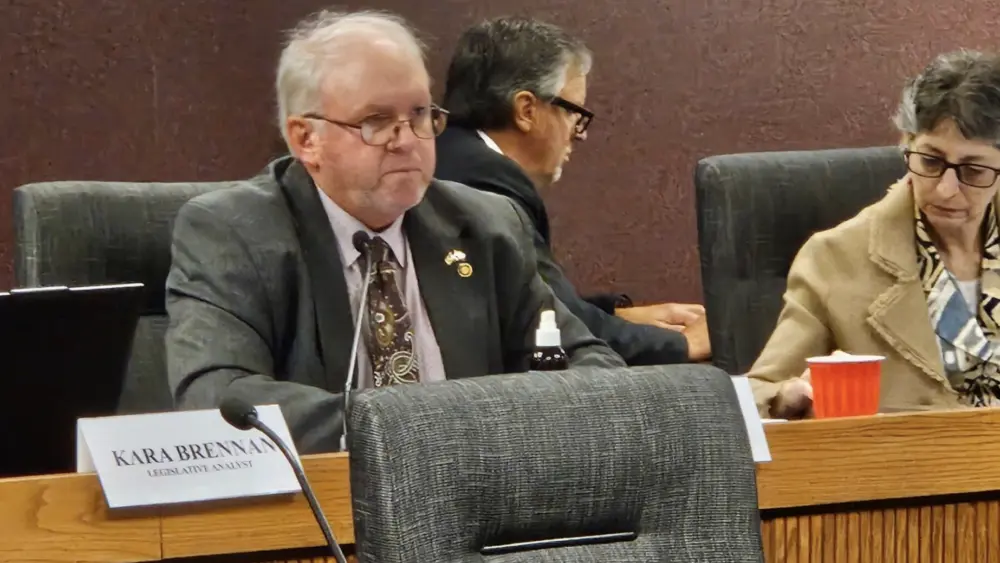
The bill growing out of an interim committee’s work would set separate tax rates for different types of property and set appraisals at replacement costs rather than sale value
BY: RUDI KELLER
Missouri Independent
Property tax bills would look different next year, with separate rates for each type of property, under a measure given first-round approval Wednesday in the Missouri House.
The proposal from state Rep. Tim Taylor, a Republican from Bunceton, would also move all local tax elections to November, change how the taxable value of homes and commercial property is calculated and limit when homes rented for short-term stays can be taxed as commercial property.
The wide-ranging bill is designed to quiet public outrage over rapidly rising tax bills tied to biennial reassessments.
“Our tax system is a mess in many ways,” Taylor said. “It did not become a mess overnight. It became a mess over a long period of time.”
The bill won first-round approval on a voice vote. A final roll call vote is needed to move the bill to the state Senate.
Last year, Taylor chaired the Missouri House Special Interim Committee on Property Tax Reform, which toured the state to take testimony. The bill debated Wednesday grew out of that work, he said.
Some of the changes are technical in nature, such as allowing tax bills to be paid in installments in every county of the state.
Other provisions include:
- No local government would be able to describe a ballot measure as a “no tax increase” tax proposal.
- All tax measures would be labeled with a letter or number instead of a descriptive term.
- Changes the market value used for assessments from the amount that would be realized at a sale to “the actual replacement cost or costs of the real property and improvements.”
- Tax proposals on the ballot would be stated in the additional tax due per $100,000 of market value.
- The value of newly constructed buildings or improvements to buildings would no longer be excluded from the calculation of whether a rollback is required.
The bill’s directive to implement separate tax rates for various types of property will have the biggest impact on individual taxpayers, Taylor said.
“This bill is crafted in a way that it is going to make substantive changes for our taxpayers and bring stability to their issues we heard so much about as we went across the state,” Taylor said.
Calculating tax rates
When Missouri governments set property tax rates, they are stated as an amount to be charged for every $100 of assessed value. The minimum tax rate for school districts, for example, is $2.75 per $100 of assessed value.
Each of the state’s 2,811 taxing districts has a tax rate ceiling, which is the highest rate it is allowed to charge. The ceiling may be different from the actual rate charged.
Under the 1980 Hancock Amendment to the Missouri Constitution, revenue from property taxes in each district is allowed to increase annually by the rate of inflation. When property values rise after the biennial reassessment cycle, if the tax rate ceiling would produce revenue in excess of the limit, taxing authorities are required to reduce the ceiling.
Everywhere in Missouri except St. Louis County, taxes are uniform for all property subclasses — residential, commercial, agricultural and personal. If values on one type of property rise faster than for others, the owners in that subclass pay a bigger share of the total taxes while other property owners pay less.
That happened in Hamilton in Caldwell County last year. Commercial assessments in the town of about 1,700 increased by 200% or more and tax bills for those properties rose dramatically even as tax rates in some districts that include Hamilton declined moderately.
In St. Louis County taxing districts have charged separate rates for each subclass since 2003. As a result, residential properties generally pay the lowest rates, followed by commercial property owners.
In four St. Louis County school districts, the spread between the rates paid by homeowners for residential property is more than $2 per $100 of assessed value.
The largest difference is in the Bayless School District in south St. Louis County, where the residential rate is $2.788 per $100 while the personal property tax rate — paid on autos, trailers and boats — is $5.3231 per $100.
During reassessment last year, the assessed value of residential property in Bayless School District increased 16.4% and the tax rate fell 9.5%. The assessed value of personal property declined 2.9% and the tax rate was unchanged.
Creating separate tax rates for each property subclass is called “siloing” the rates. The change is intended to end the process that has shifted the tax burden away from farms, railroads and utility companies to homeowners and commercial businesses.
“To me, that is the base of this entire bill,” Taylor said. “It is the foundation.”
Other provisions
The siloing provisions of the bill received little debate compared to altering election dates and questions about whether the proposed changes are too expansive.
Currently, taxing districts can call an election for bond issues or tax increases on several dates during a year. The bill would require all tax elections to take place at the November general elections in even-numbered years.
Other election dates can have extremely low turnout, and that appeals to district directors seeking a tax increase, Taylor said.
“There are those taxing entities that will seek to get the lowest voter turnout time so they can get their voters out,” he said.
Other members questioned whether that will allow the flexibility to meet emergencies.
“You can’t adequately plan it if you have to wait two years for the election to come around,” said state Rep. Eric Woods, a Democrat from Kansas City.
State Rep. Rodger Reedy, a Republican from Windsor who was vice-chair of the interim committee, said limiting election dates could deprive agencies like fire or ambulance districts the money needed to meet public service demands. He said he did not see a problem having tax elections on days with low turnout.
“People have the freedom to vote,” Reedy said. “They have the freedom not to vote.”
Information about local tax measures could be swamped by the messages from candidates or statewide ballot measures where campaigns are spending millions of dollars. Ballots could grow to multiple pages that confuse voters as well, said state Rep. Bill Falkner, a Republican from St. Joseph.
“What they are doing is they are going to vote on the first page and leave the rest blank,” he said.
The number of changes in the way taxes are calculated and set could make implementation difficult, said state Rep. Peggy McGaugh, a Republican from Carrollton.
“We need to slow our roll out a little bit and we need to talk to the counties and we need to talk to the townships about how this will be implemented,” she said.
Taylor acknowledged that there will be districts that gain and districts that lose under the legislation but said he thinks the results will be acceptable to all.
And, he said, it will be up to future lawmakers to adjust the provisions that go too far.
“For the years to come,” he said, “this body is going to be responsible for additional changes and cleaning up something that is quite complicated and where people are getting hurt in many ways.”